The discovery of viruses began with investigations into tobacco mosaic disease in the late nineteenth century. Adolf Mayer first demonstrated that sap from diseased tobacco plants could transmit the disease to healthy plants, showing that the disease was caused by an infectious agent, although he could not identify or cultivate it. Dmitri Ivanovsky later showed that the infectious agent could pass through a Chamberland filter, indicating that it was smaller than bacteria, but he suspected it might be a toxin because it could not be cultured. Martinus Beijerinck further demonstrated that the agent was a living, reproducible particle that could multiply only in living plant tissues. He called it contagium vivum fluidum, meaning contagious living fluid. These experiments led to the discovery of Tobacco Mosaic Virus (TMV) and established the basic characteristics of viruses as infectious, filterable, submicroscopic agents that cannot grow on artificial media but require living cells for replication.
Lesson one
Virology questions
Viral Structure
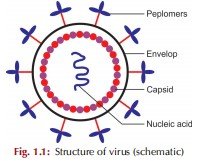
1. Viruses are unique microorganisms made mainly of nucleic acid and a protein coat called the capsid
2. The capsid is made of capsomers, and together with the nucleic acid forms the nucleocapsid
3. Viruses may have an outer lipoprotein envelope with glycoprotein projections called peplomers.
4. Viral symmetry is mainly **icosahedral or helical**, with helical symmetry occurring in RNA viruses and always being enveloped in human viruses.
5. Viruses contain either DNA or RNA, never both and their nucleic acid may be single- or double-stranded.